Louise Laboine’s blue evening dress
Maigret and the Dead GirlLouise Laboine’s blue evening dress serves as a material clue in the investigation and a point of connection between the unidentified girl in the newspapers and the person remembered by those who had seen her. Its faded fabric and shop label offer practical leads, while its appearance in a late-night account places a girl wearing a blue evening dress outside Le Roméo shortly after midnight. The garment thus moves between ordinary use, police inquiry, and public recognition without, by itself, resolving the mystery of Louise’s identity.
Identification Through the Garment
The dress is examined closely enough for investigators to notice what ordinary wear has done to it. It had been washed many times; when the hem was undone, the color underneath was also found to have faded. The detail makes the dress more than a generic description of clothing: its condition records repeated use, while the difference revealed at the hem offers a small, concrete indication of the garment’s history. The evidence does not specify who washed it or when, so its wear remains a trace rather than a complete account of Louise’s life.
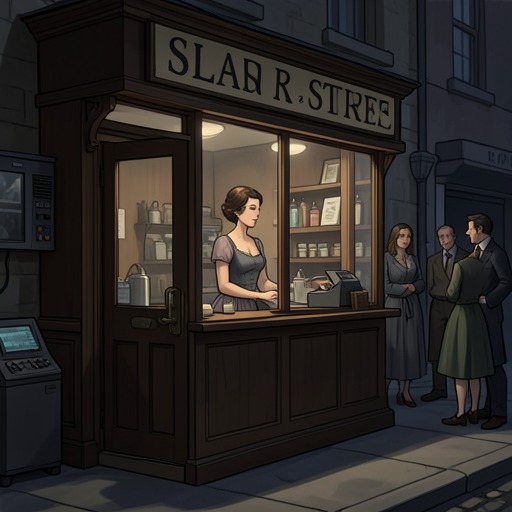
A tab inside the garment gives the name of a shop and an address: 35b Rue de Douai. That label supplies a route from the object to a place where someone might recognize it. The police ask a woman associated with the shop whether she knows the dress, whether she sold Louise a dress, and whether she found one that would fit her. These are questions, not independently confirmed answers in the available evidence; their importance lies in how the investigation uses the garment to test a possible connection between Louise and the shop. The dress can be examined and its label read, but those physical particulars still require human recognition and testimony to become a fuller account.
A Garment in Louise’s Recent Movements
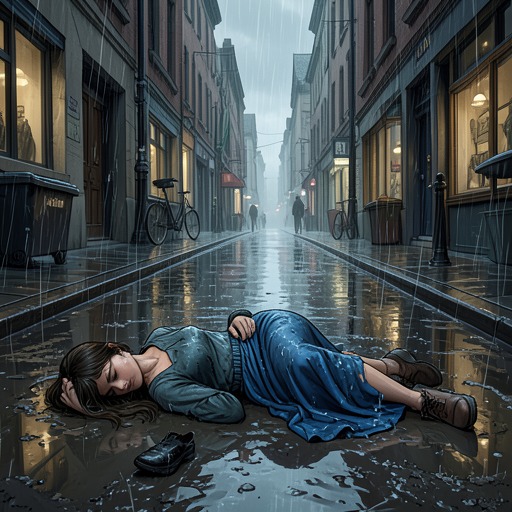
A separate account places a girl in a blue evening dress and a dark velvet cape outside Le Roméo at about a quarter past twelve. It was drizzling. A taxi driver called to her, as he usually did, offering a taxi; she continued walking and declined with a shake of her head. This recollection gives the dress a specific setting and moment, rather than leaving it only as an item examined after the fact. It also records an ordinary choice: she was offered transport and did not take it. The account does not establish where she went next, or identify the garment by its label, but its description makes the blue dress a useful point of comparison in reconstructing her movements.
The shop and the late-night sighting belong to a short stretch of Louise’s final known life. The evidence links a dress associated with a Rue de Douai shop to a girl seen leaving Le Roméo in similar clothing, and records investigators asking questions intended to establish the shop connection. It does not provide a definitive account of when Louise acquired the garment or establish every step between the shop and the sighting. Preserving that distinction matters: the garment narrows the inquiry through identifiable details, but it cannot supply answers that the testimony has not yet confirmed.
The Dress and the Newspaper Image
The dress also sits beside a change in how Louise is seen. The first edition of the evening papers appeared at about one o’clock, and carried the same photograph as the morning papers. Maigret was startled by the photographs’ quality. The image brought before him a version of the girl unlike the one he had seen in the rain at Place Vintimille or glimpsed later at the Medico-Legal Institute: it was as she must have looked the previous evening when she entered Mademoiselle Poré’s shop. The account associates the shop visit with the picture, but does not say that the photograph itself depicts the dress; the garment and image are connected by the investigation’s attention to that visit, not by an explicit description of what Louise wore in the photograph.
The photograph’s lifelike expression unsettles any simple reduction of Louise to the label of a case. Maigret thinks that calling her merely pretty misses something harder to define; her eyes seem to pose an unanswerable question. Against that image, the dress offers a different kind of evidence: not an expression, but a worn object bearing a shop address. The newspaper image can make Louise recognizable to readers, while the garment can direct investigators toward someone who encountered her in person. Neither form of evidence, alone, restores the full person.
Material Trace and Personal Recognition
The story places clothing and photography in contrast without making either a complete substitute for memory. The dress is materially specific: it has a faded color, a repeatedly washed surface, a hem that can be opened, and a tab carrying an address. The photograph is immediately public, reproduced in successive editions and capable of presenting Louise with an expression that appears alive. One object points backward through use and manufacture; the other circulates her image after her death. Together they make the investigation’s problem visible: evidence can establish traces of a life, but recognition depends on people who knew how to connect those traces with a name.
That distinction sharpens when the narrative recalls that Louise had once been surrounded by ordinary relations. She had a father and a mother, and later made friends at school; people knew her as she grew up, spoke with her, and called her by name. The dress’s shop label and the newspaper photograph belong to a later effort to identify her from outside those relationships. The questions put to the shopkeeper, and the separate question about whether a witness recognized the newspaper photograph, show recognition being actively sought rather than assumed. The blue evening dress matters, finally, because it is both an everyday possession and a surviving clue: its particular details help retrace Louise’s movements, while its limits underscore how much of the person behind the public image remains beyond what an object can tell.